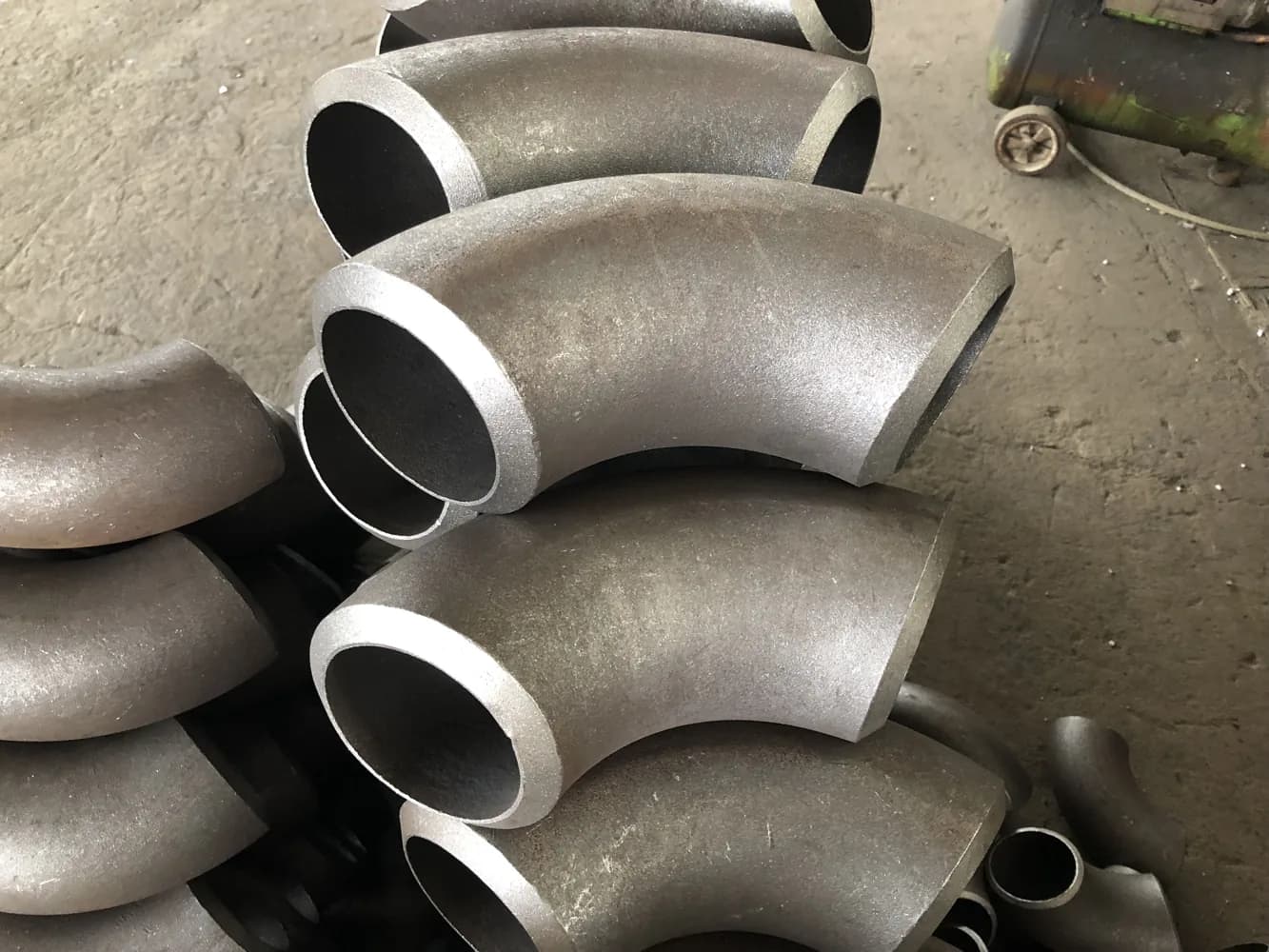
Why This Matters for Your RFQ
When you spec "A234 WPB" on a purchase order you are pointing at three things at once: a chemistry envelope, a forming-temperature window, and a heat-treatment regime. Get any of those wrong and the fittings either fail acceptance, weld badly on site, or crack in service.
This article walks through what the standard actually requires, with the real numbers a procurement engineer needs in front of them when reviewing an MTC.
Chemical Composition Envelope (Heat Analysis)
For Grade WPB fittings made from steel pipe or plate:
| Element | Maximum |
|---|---|
| Carbon (C) | 0.30 % (heat analysis) |
| Manganese (Mn) | 0.29-1.06 % (sliding) |
| Phosphorus (P) | 0.050 % |
| Sulfur (S) | 0.058 % |
| Silicon (Si) | 0.10 % min (no max for plate/pipe-derived) |
| Cu + Ni + Cr + Mo | 1.00 % combined |
| Cr + Mo | 0.32 % combined |
Sliding manganese rule: For each 0.01 % reduction in carbon below 0.30 %, manganese maximum increases 0.06 % up to a ceiling of 1.35 %.
Carbon Equivalent (CEV): maximum 0.50 by heat analysis using the formulaCEV = C + Mn/6 + (Cr + Mo + V)/5 + (Ni + Cu)/15
A high CEV means the fitting will be harder to weld in the field without preheat — keep this in mind for projects with limited site welding equipment.
Hot-Forming Temperature Window
Per A234, hot-formed WPB fittings whose final forming operation is completed above 1150 °F (620 °C) and below 1800 °F (980 °C) need not be heat-treated, provided they are cooled in still air.
Outside that window — for example, fittings that are formed cold or hot-formed and quenched — full heat treatment per the standard's normalising or annealing requirements applies.
Post-Weld Heat Treatment (PWHT)
When fittings are welded to mating pipe in the field, A234 references a PWHT range of 1100-1250 °F (595-675 °C), followed by radiographic examination on the welded zone. If you are buying fittings for high-temperature steam service or seismic-zone refineries, make sure your PO requires:
- PWHT chart recorder traceability (time-temperature curve)
- Holding time per inch of wall thickness
- Cooling rate limits
What to Verify on the MTC
When the MTC arrives, check that:
- Heat number on certificate matches the hard-stamp on the fitting body
- All elements above are reported, with CEV calculated
- Cu+Ni+Cr+Mo and Cr+Mo combined values fall within the limits
- Heat treatment record accompanies the cert (normalising or as-formed declaration)
Common Field Issues
- High carbon (> 0.30 %) on lots claiming WPB: check CEV — if CEV > 0.50 the fitting may technically meet WPB chemistry but will give your welders trouble on site.
- Missing PWHT after field welding: code violation if your project is under ASME B31.1 or B31.3 with the relevant material/thickness combinations.
- Mother-pipe heat number missing on the cert: for processed fittings (elbows, tees) the standard requires both the finished-fitting MTC and the mother-pipe MTC.
This article is a buyer's reference based on the public standard. The published ASTM A234 (latest edition) takes precedence for any commercial transaction.
Related Products
For physical supply of the specs discussed above, refer to the relevant Hebei Haihao product categories:
Or browse the full product catalogue and filter by ASTM / ASME / EN / GB standards, material grades, and size ranges.
Further Reading
Next Steps
- This article is a procurement reference; all standard numbers, chemistry limits, and process parameters defer to the latest published edition
- For project RFQs, submit your specs via the inquiry form; we respond within 4 business hours
- Factory certifications and inspection capability are listed on the certificates page
Need a quote for the products mentioned in this article?
Submit your specs and our pressure piping team will respond within one business day.
Send RFQRelated reading
TechnicalNDT for Pipe Fittings: PT vs MT vs UT vs RT Guide
Four common NDT methods are used on buttweld fittings and forged flanges. Each catches different defects — pick the wrong one and you ship the flaw.
Technical