What "Sour Service" Means
A "sour" environment is one where wet hydrogen sulfide (H₂S) is present in the produced fluids — common in upstream oil & gas (well streams, gathering lines, processing plants) and in some refining streams.
H₂S in the presence of water causes two main attack modes:
- Sulfide Stress Cracking (SSC): sudden, brittle fracture of high-hardness steels under tensile stress
- Hydrogen-Induced Cracking (HIC): internal blisters in plate and pipe driven by hydrogen accumulating at inclusions
Both are catastrophic. NACE MR0175 / ISO 15156 is the international standard that lists prequalified materials and their use limits to prevent these failure modes.
How the Standard Is Organised
NACE MR0175 / ISO 15156 has three parts:
| Part | Coverage |
|---|---|
| Part 1 | General principles and requirements for resistance to SSC |
| Part 2 | Application requirements for Corrosion Resistant Alloys (CRAs) — duplex, super-duplex, Ni-based alloys |
| Part 3 | Requirements for carbon and low-alloy steels in wet H₂S environments (incorporates the former NACE MR0103) |
Material Requirements That Hit Pipe Fittings & Flanges Daily
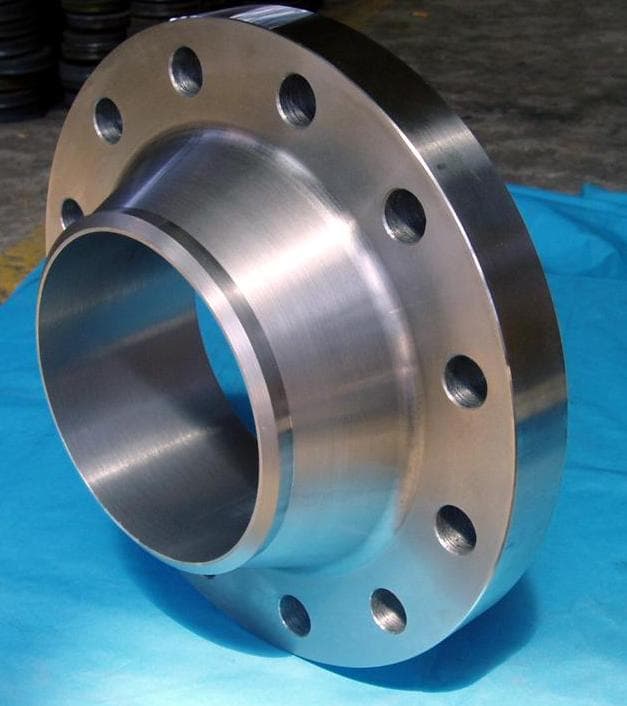
ASTM A105 Forged Flanges (most common case)
What NACE MR0175 / ISO 15156-2 itself mandates for carbon-steel forgings in sour service:
- Maximum hardness: 22 HRC (≈ 237 HV / ≈ 200 HBW) for the parent material, with the A105 base spec already capping HBW at 187 — so 187 HBW is the practical ceiling
- Heat-treatment requirement: hot worked, hot worked + tempered, annealed, normalised, normalised + tempered, or quenched + tempered are acceptable (per ISO 15156-2 §7.2)
- HIC resistance for plate-derived items per NACE TM0284 if specified
Owner specifications (Shell DEP, Saudi Aramco SAES, TotalEnergies GS, ADNOC, Petrobras, etc.) commonly add the following stricter limits beyond NACE itself — verify what your project actually requires:
- P ≤ 0.015 – 0.025 % (vs A105 base 0.035 %)
- S ≤ 0.010 – 0.015 % (vs A105 base 0.040 %)
- CEV ≤ 0.43
- Mandatory normalising after forging
The hardness limit is the killer. A standard A105 mill test can show 200+ HBW; getting consistently below 187 HBW requires:
- Tighter chemistry control (lower P, S, CEV)
- Mandatory normalising after forging
- Avoiding cold work (e.g. no cold sizing of the flange face)
ASTM A234 WPB Buttweld Fittings
Also subject to 187 HBW max for sour service. Same heat-treatment-after-forming requirement applies.
CRA Materials
For 22Cr duplex, 25Cr super-duplex, 6Mo super-austenitic, Inconel 625/825/925: refer to ISO 15156-3 partial pressure curves to determine acceptable H₂S range. CRAs are not "always sour-service immune" — each grade has limits.
What MR0175 Demands on the MTC
Every fitting and flange supplied to NACE MR0175 must have an MTC that proves:
- Heat number traceable to the marked component
- Chemistry within the NACE-restricted envelope (P, S, CEV)
- Brinell hardness measurements — typically 5 readings, with all readings and the maximum recorded
- Heat treatment record (normalising temperature, time, cooling)
- Statement on the certificate: "Material complies with NACE MR0175 / ISO 15156 requirements for sour service"
If the certificate does not specifically say "complies with NACE MR0175", treat the part as not qualified — even if the chemistry happens to match.
For HIC-Susceptible Items
For plate-derived items (heads, plate-rolled fittings, certain large OD components), additional HIC testing per NACE TM0284 may be specified. TM0284 itself is a test method and does not set acceptance criteria — those are agreed between purchaser and manufacturer. The de-facto industry acceptance widely adopted (referenced in EFC 16, MR0175 Annex B examples and most owner specs) is:
- Crack Length Ratio (CLR) ≤ 15 %
- Crack Thickness Ratio (CTR) ≤ 5 %
- Crack Sensitivity Ratio (CSR) ≤ 2 %
Always confirm the contractual acceptance numbers in your project specification.
For SSC of welded zones, NACE TM0177 may be specified.
Differences vs NACE MR0103
NACE MR0103 was historically the standard for refinery downstream wet H₂S service. Since 2015 ISO 15156 / MR0175 has expanded to incorporate refinery service in Part 3, and MR0103 is being phased out in many specifications.
If your project specification still calls "MR0103", clarify with the project engineer whether MR0175 Part 3 (current) is acceptable. Most newer EPC specs default to MR0175 alone.
Common Procurement Mistakes
- Specifying "A105 NACE" without hardness limits. "NACE compliant" is not a single number — write "A105 N (normalised) per ASTM A105 + NACE MR0175 / ISO 15156-3, max hardness 187 HBW".
- Accepting the cert without independent hardness check. On critical service, witness the hardness test or have a third-party inspector (SGS / BV / TÜV / DNV) verify the 5-reading set.
- Forgetting weld procedure qualification. A NACE-compliant flange welded to a pipe with a non-qualified WPS that produces a hard weld zone is non-compliant. WPS/PQR for NACE service must show the HAZ hardness ≤ 248 HV (typical).
- Mixing A105 (NACE-compliant) with A350 LF2 (also NACE-compliant) without checking the project's interchangeability rules. Both can meet NACE separately, but the project specification often locks to one.
Buying Checklist for Sour Service
- [ ] PO names "NACE MR0175 / ISO 15156" and the part number (Part 3 for carbon/low-alloy)
- [ ] Maximum hardness specified explicitly (187 HBW for A105/A234)
- [ ] Heat treatment requirement explicitly written ("normalised" not "as forged")
- [ ] MTC required to include hardness readings + NACE statement
- [ ] HIC test (NACE TM0284) for plate-derived items in critical service
- [ ] WPS/PQR for any field welding qualified per NACE limits
- [ ] Third-party inspection witness on hardness for first article and random lots
This article is a buyer's reference. Project specifications must follow the latest NACE MR0175 / ISO 15156 edition.
Related Products
For physical supply of the specs discussed above, refer to the relevant Hebei Haihao product categories:
Or browse the full product catalogue and filter by ASTM / ASME / EN / GB standards, material grades, and size ranges.
Further Reading
Next Steps
- This article is a procurement reference; all standard numbers, chemistry limits, and process parameters defer to the latest published edition
- For project RFQs, submit your specs via the inquiry form; we respond within 4 business hours
- Factory certifications and inspection capability are listed on the certificates page
Need a quote for the products mentioned in this article?
Submit your specs and our pressure piping team will respond within one business day.
Send RFQRelated reading
 Standards
ASTM A182: Forged Alloy and Stainless Piping Components
ASTM A182 covers forged low-alloy and stainless steel flanges, fittings, valves, and parts for high-temperature service. This guide explains what buyers must specify beyond the standard, including grade, heat treatment, and dimensional standards.
 Standards